Showing posts with label E.P.A.. Show all posts

Wednesday, April 18, 2012

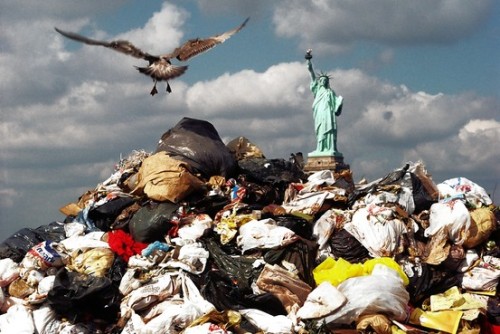
Getting the Facts on Garbage


Photo: The Wall Street Journal
Did you know that every year we throw out enough plastic film to shrink-wrap the state of Texas? Or that the widely accepted E.P.A. figure of 4.4 lbs. of trash per person per day has actually been upped to 7 lbs. as a result of more recent survey by Columbia University?

These tidbits and more can be found in last Saturday’s edition of The Wall Street Journal. In Edward Humes’ “Grappling With a Garbage Glut,” Better BTU was thrilled to find an article that was comprehensible for the everyday reader and the expert alike.

As industry professionals, we’ve heard the figures designed to jolt consumers into the reality of how wasteful our society has become. We skim over facts about how many football fields our trash can fill up without batting an eye. So often we discuss waste in terms of billions of tons that it begins to lose its effect on us. That’s why it’s best for even the most advanced to go back to the basics every once in awhile and Humes’ article helps us do just that.  

In 2009, a team of researchers from the Massachusetts Institute of Technology decided to track its garbage the way other scientists follow migrating birds. After attaching electronic chips to its garbage, the team followed the trash trail as it traversed the continent on the road to recycling or an out-of-state landfill.

The U.S. has seen its number of landfills shrink from 18,500 to 1,900 in the past 30 years. While that is generally considered a good thing, most of us don’t think about how that increases the cost of transporting trash. The state of New York spent more than $300 million last year trucking its waste to out-of-state landfills, up to 300 miles away. It’s also worth noting that trash is now the number one export for America. While China’s leading export to the U.S. is computers, we fill up cargo containers with scrap cardboard for the return trip East.

Book Release Date: Apr. 19, 2012
But it doesn’t have to be like this. While our industry is working hard on making waste-to-energy technology more cost-effective, dramatic efforts have been made overseas to cut down on the amount of product packaging, which accounts for almost one-third of U.S. waste. European countries charge manufacturers, not taxpayers, for package waste and it’s made a difference.

Humes discusses different waste-to-energy projects and philosophies on both sides of the Atlantic and examines Waste Management’s experiment using S4 Energy Solutions’ plasma gasifier in conjunction with its landfill in Arlington, Ore. His book Garbology: Our Dirty Love Affair With Trash hits bookstores on Apr. 19th and we can assure you that there will be a copy on the shelves at Better BTU. 


The Wall Street Journal: Grappling With a Garbage Glut (Apr. 14, 2012)

Tuesday, April 3, 2012

Wanted: A Guide Dog, Not A Watch Dog


There have been debates about how involved the government should be in overseeing the development and implementation of renewable energy projects in the U.S. The E.P.A. already regulates emissions and some think it should take on a larger role to ensure that new technologies reduce the carbon footprint. Here at Better BTU, we’ve studied this matter in depth and continue to debate amongst ourselves. One thing we call all agree on is that it might be good to take a page from the European Union’s book.


In 2009, the European Commission established the Renewable Energy Directive, a committee that studied and reported on sustainability criteria for biomass. While the Commission elected to adopt a report on sustainability requirements for use of solid biomass and biogas in electricity and heating, they stopped just short of making it legally binding. 

Biomass Technology Group, out of The Netherlands, compiled a report for the Commission in February 2008 on the benefits and drawbacks of sustainability criteria as well as certification systems for biomass production. The study acknowledged that while biomass certification would guarantee greenhouse gas savings and protect biodiversity such as high conservation forests and wildlife habitats, the cost would form a serious barrier to small biomass producers.

Instead, the Renewable Energy Directive asked each member of the EU to file a national action plan yearly and recommended criteria relating to, among other things:

(b) a common greenhouse gas calculation methodology which could be used to ensure that minimum greenhouse gas savings from biomass are at least 35 percent (rising to 50 percent in 2017 and 60 percent in 2018 for new installations) compared to the E.U.’s fossil energy mix


The goal of this strategy is to advise member states on development in order to minimize risk of “varied and possibly incompatible criteria at the national level, leading to barriers to trade and limiting the growth of the bioenergy sector in the European Union.”

On this side of the pond, 17 of 50 states have adopted a Renewable Portfolio Standard that mandates that by 2020 a certain percentage of the state’s energy come from renewable energy sources. The states are free to pursue this goal in any matter, and while we like that it promotes growth in the industry through trial and error, it also lacks an overarching set of standards to help customers understand exactly what they are purchasing.

We’ve discussed the need for a standardization of language in the past (see Gasification: Definition, Please! and Definition Please - Part II) but we also would like to see a set of standards for calculating greenhouse gases so that you can compare technologies across a baseline. Currently, there is quite a bit of variety on how companies arrive at these numbers (ex. Is the fuel consumed by transportation or processing outside the biomass facility included?).

Environmental Protection Agency Watch Dog?
At Better BTU, we all agree that what we need is more leadership, not more regulations. Whether that leadership comes in the form of a government committee set up to develop a national roadmap for states to achieve its renewable energy goals or a non-partisan third party institute remains to be agreed upon. There are concerns that if it becomes a governmental issue, it will end up being run by the E.P.A. which has become known for being more political than practical.

We recognize that what works for Alabama won’t work for Wyoming and we don’t want to create a mold that everyone must try to fit in. But a group that can create a national roadmap for sustainability through clarification of definitions and rules of engagement could be exactly the type of guide dog this country needs.

Other Resources: